Geoveneer
The geometry of veneering
curved surfaces
Research into the relationship between surface geometry, veneer deformation and seam arrangement. The pattern becomes a computational object as well as a fabrication and design choice.
 Digital model
 Fabrication
A geometric
incompatibility
A flat sheet can wrap around a cylinder without stretching. This is not the case with a sphere: forming it requires deformation within the plane of the sheet. With veneer, this geometric challenge is compounded by the directional properties of wood.
Dividing the surface into elements limits the deformation each must accommodate, but introduces joints. The task is therefore not just to draw a pattern: it involves balancing design continuity, the number of seams and the deformation the material can tolerate.
Curvature, deformation
and seams
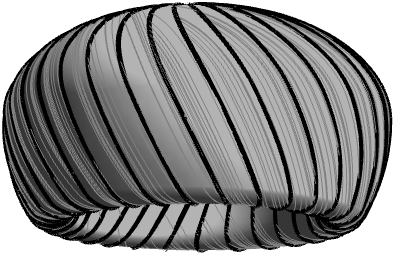
The modelling work aims to connect surface curvature to the deformation required for flattening and forming. Seams—the boundaries between veneer elements—become variables in the problem: their position and arrangement change how each element deforms.
The mathematical formulation focuses on three questions: can a minimum seam length be estimated for a given tolerance? Under what conditions is a strip-based decomposition efficient, or even optimal? How can the search be restricted to relevant families of cuts rather than every possible configuration? These questions are studied using models whose assumptions and range of validity must be made explicit.
From the calculated pattern
to the real veneer
The calculated pattern must become an assembly that can be cut, handled, glued and formed. Grain orientation, the integrity of each piece and the laying sequence are part of the fabrication problem, just as geometry is.
Making allows cutting choices to be tested against the actual behaviour of veneer. An opening joint, a fold or a fracture is more than a defect to correct: it is also an observation that questions the model’s assumptions and limits.
From the process
to its formalisation
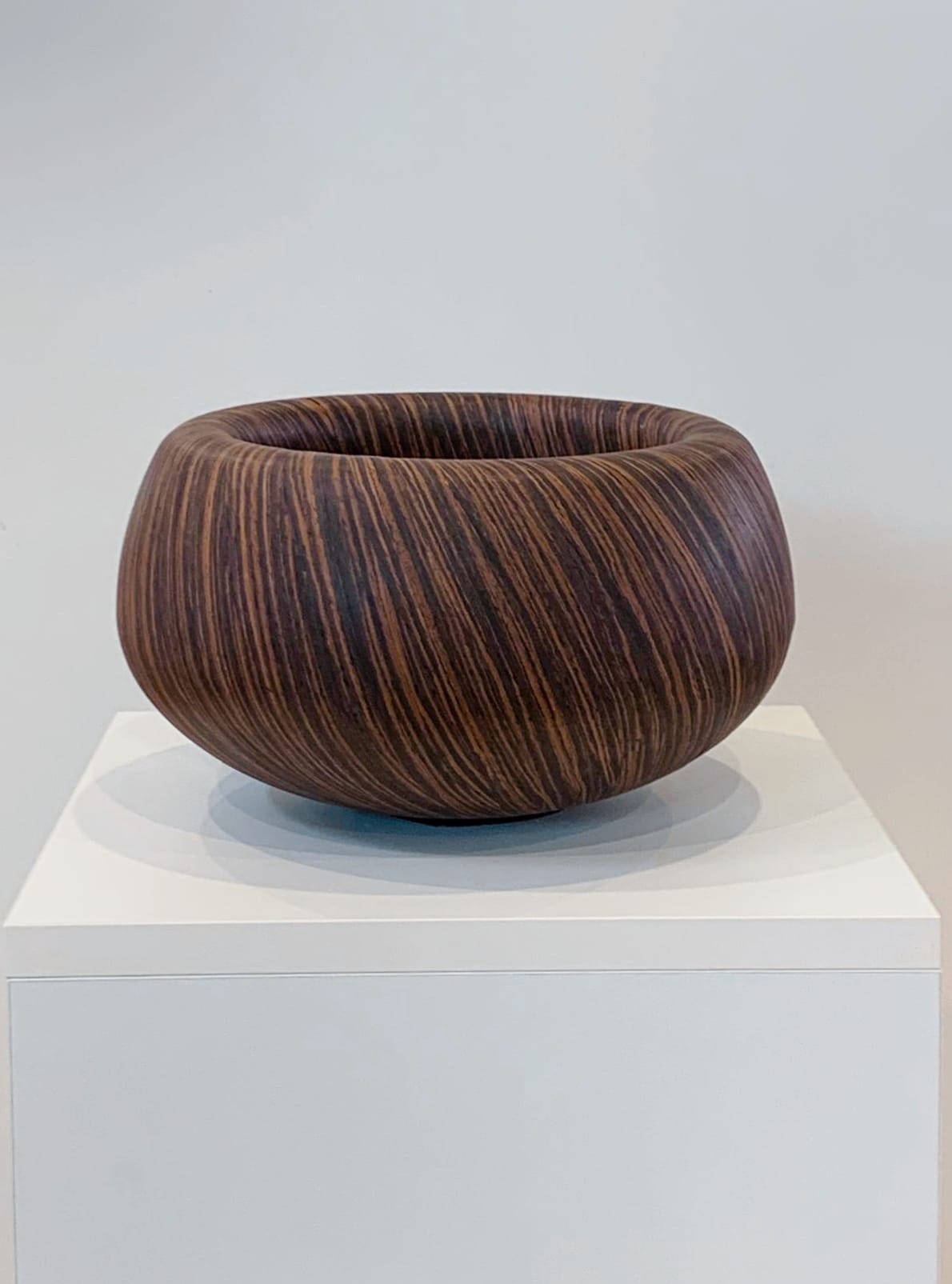
Objects, panels and curved pieces made in the workshop give material form to the Geoveneer process. Joint layout and grain orientation contribute to their expression: computation plays a role in construction and design alike.
The theoretical work seeks to explain why certain arrangements work, when they can be improved and how far the results can be generalised. The aim is not a universal solution to pattern-making, but verifiable relationships between form, deformation and cutting.